Saturday, June 06, 2009

Toby’s Road Trip

Toby, my young German friend currently living in Vienna, came to visit for the month of February. For a visitor, a month is a long time to spend in San Miguel, unless you’re taking an art or language course. So we decided that his visit needed to include a road trip. Having successfully traveled together for a month in the Yucatan, five years ago, we knew that we wouldn’t kill each other.

We mapped out our plan; Morelia and Pátzcuaro (with daily side trips), returning through Queretaro. Other than Queretaro, every place was new to me.

Toby proved to be an amazing co-pilot. He was adept at map reading and despite my frequent concern he always managed to get us where we were going.

Our first stop was Morelia. I loved it. At least I loved centro. Like most old Mexican cities, the outskirts of town are sprawling, industrial and ugly. But in the center of town history remains; colonial architecture preserved.

The cathedral in Morelia

As a University town there was a youth and vitality about it that one doesn’t really experience in San Miguel (what with all the retired people living here). Sidewalk cafes filled with students, talking or studying, not a gringo in sight.

Toby whipped out his guide book and had our walking tour all planned. In addition to the main cathedral, we walked through museums, government buildings, and the conservatory of music. I was impressed by how well everything was maintained. (And all the handsome young Mexican’s didn’t go unnoticed either.)

Toby's self portrait in Morelia

Having checked everything off Toby’s list within a couple of hours, we decided to press on to Pátzcuaro.

Pátzcuaro spoke to me. Situated in a pine forest, I found myself feeling at home in the trees. There are two large central plaza’s surrounded by restaurants and hotels. What surprised me was that the town is behind a hill or small mountain and therefore there are no views of the lake. Nonetheless, the town has charm.

We set out in search of accommodations. Had our budget allowed, we would have stayed at a beautiful boutique hotel called Casa de la Real Aduana (http://www.realaduana.com/). At the discounted rate of $180 USD per night, we would have had to share a bed. But instead Toby got the skinny from a couple at a restaurant and for about $150 USD less we stayed at Posada Mandala. There we each got our own bed but had to share a bathroom with the room across the hall. Enrique, the one-legged owner, was gregarious and very proud of the number of times his name appears on Trip Advisor.

After breakfast the next morning, Toby whipped out his guide book and we set off for Paricutin.

Paricutin is about a two hour dive from Pátzcuaro. Toby’s guidebook explained that in 1943 a small volcano erupted and buried the town, with the exception of the church which today is the only building poking up through the lava.

There is not much else to see in the region and I was doubtful that the drive was going to be worth the experience. However, I was not disappointed and it was probably the highlight of our trip.

We pulled off the main highway into a nothing of a town. Waiting by the side of the road were young men and horses. They kept trying to flag us down but we, being savvy travelers, simply sped past them. Undeterred, they mounted their horses and a pursuit ensued. (I have to admit that this was a unique experience for me; my car being chased by cowboys.) The road was so rutted that the horses had better footing than my car and within a few minutes the riders were leading us instead of following.

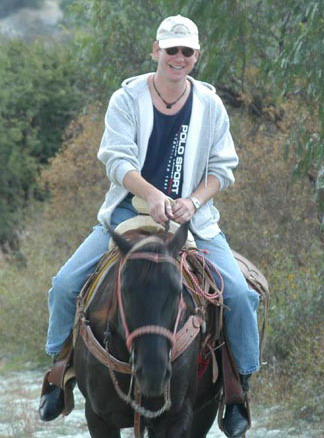
We were directed to a parking lot where it was explained that to get to the site was a long hike and that we’d be better served to go on horseback. The price was reasonable so we agreed (and later were glad that we did). I was expecting that we’d drive to some lookout point, say something like, “Wow, that’s cool,” get back in the car and return to Pátzcuaro. Not so. Instead we rode through dusty wooded trails with our guide, a small indigenous man who speaks English, Spanish, French and his native tongue “Purepecha.”

At the end of the trail we had to dismount and continued on foot over a small rise. There, unlike the U.S. where we’d be standing behind a fence or velvet ropes or some type of barrier, we were allowed to climb all around and into the remains of the church. And we were nearly the only people there. Very cool. (A picture is a must here.)


Back in Pátzcuaro we dined, at the recommendation of a friend, at Cha Cha Cha. The owner is from the San Francisco bay area and he explained that he prefers Pátzcuaro to San Miguel because there are more trees and fewer gringos. And with Morelia only 45 minutes away, he has the best of country and city life. (I want to go back and explore this further.) He also said that Morelia has a hopping gay scene.

The next morning Toby whipped out his guide book and I whipped back. Enough time in the car. I want to explore Pátzcuaro. I want to go to the island in the center of the lake.

Down at the pier we buy our tickets and are ushered into a long narrow boat with an outboard engine. Accompanying us are the locals, laden with bags of potatoes and vegetables to take to the island. A sign says that the boat’s capacity is 80 people. (I wonder how many bags of potatoes that includes.) The indigenous people appear more native; smaller, darker, less European blood if any. They still wear traditional dress with bright embroidered skirts, aprons and puffy blouses. A young woman breasts feeds an infant while chatting with a wizened grandmother. The language spoken is not Spanish. I notice only one other tourist. A young woman reading a book, who might be beautiful if not for the pierced lip and dreadlocks.

The boat trip is about 30 minutes. The lake is huge, dirty but not disgusting. Our boat stops while the fishermen paddle out and perform something of a show with their unique butterfly nets. After the brief show they paddle over to our boat for tips.

On the island we hike to the monument at the top. There are a multitude of little shops and food vendors but many are closed. We are not there at peak tourist season. Peak tourist season is for Dia de los Muertos (or Day of the Dead) when the island swarms with visitors.


The island at Pátzcuaro

Back by the boats we sit in a restaurant but only order cokes. We don’t feel good about the food being served on the island. We’ll wait until we get back to town.

Back on shore we share a taxi with a charming Swedish woman who was there doing some kind of research (I don’t remember what kind). After dropping her off we find a restaurant on the square and order lunch. A man with a booming baritone voice serenades the diners for tips and offers to sell us his CD. He was good but we don’t buy a CD.

The baritone should have stayed. Because he is replaced by a boy with a guitar, who plays a single cord (if it can be called a cord) and sings at the top of his lungs some song having no relation whatsoever to the so called cord. It is painful. He is so bad that it is comical. At the table next to us is a small child in a highchair. She is adorable. (She looks just like “Boo” in the movie “Monsters Inc.”) She is twisted around in her chair staring at the singer, with a look of distinct horror on her face that clearly says, “What the fuck is that noise?” (I still regret not taking a photograph of such an adult expression on such a young face.)

Our trip back took us through Morelia again. We stepped it up a notch and stayed at the beautiful Hotel de la Soledad (http://www.hoteldelasoledad.com/english.htm), only a block from the main square. That evening as we walked to dinner, minstrels and clowns were performing for the crowds in the square.

The next morning we set out for the butterfly sanctuary, famous for the millions of monarch butterflies that breed and nest before returning to Canada in the spring. After hours of driving we came to the sanctuary. What Toby’s guide book didn’t mention was that it was a three hour hike to where the butterflies were actually nesting. This didn’t do with our schedule which was to put us in Queretaro that evening. Again, there were the horses. We explained to our guides that we didn’t have the time to hike so we would ride. What surprised us was that our guides were not on horseback but ran along beside us. They took us down sheer cliffs and through deep ravines. When going uphill, they would hang onto our horses’ tails.

It was a cloudy day and although we could see masses of butterflies hanging on branches, some of the impact was lost because of the low light. Instead of bright orange clumps, we could only see dark, packed branches. It began to rain. On our way back we passed a couple hiking in, not far from the start of the trail. “I think it’s just a littler further.” I heard the man say in English. “Oh,” I thought, “You have no idea.”

One important lesson that we learned on our trip was, if you are touring a site in Mexico and they offer you a horse, take it.

For those who fear the idea of driving in Mexico, let me stress that the roads were wonderful nearly every place we traveled. There were no bandits by the side of the road and at no time did we feel unsafe. People were friendly and went out of their way to give us information or directions. In our short trip we saw several types of topography; high desert, pine forest and jungle. There were lakes, mountains and volcanoes. At times we were on long highways without anything but farm land or vacant countryside and hardly another car on the road. It gave me an appreciation as to how vast this country is and how little people (from the U.S.) know about it other than the beaches of Puerto Vallarta or Cancun. Believe me, there is a lot more to Mexico. And the further you get away from the tourist resorts, the better it is. For me anyway.


Toby with Christine and Mario in Queretaro

Friday, June 05, 2009

Too Much Information


Adult Content Warning: If you are offended by graphic sexual discussions, I suggest that you skip this entry.

A frequent escape of ours is La Cañada de la Virgen, or rather, Alex’s cabin at the ranch; Casa Esquela.

Alex has created a space completely off the grid. Water is collected from a spring, purified and then heated by a solar hot water heater. The lights are also solar powered. There is a fully functioning bathroom.

It is kind of like upscale camping. We pack in food for the weekend, cook together, horseback ride and spend long evenings solving the world’s problems around a campfire. Toby’s visit was the perfect opportunity to share our get-away, so off we went; Rodrigo, Christine, Alex, Toby and me.

We were having lunch on the patio on the day of our departure. Laid out on the table was a spread of sandwich bread, lunch meat and vegetables. Toby, a strapping young German (straight man), was still eating well after the rest of us had finished.

Alex was reviewing our tasks to close up the house.

“Should we make up our beds?” Christine asked.

“No,” Alex said, “Strip them. I’m taking all the sheets to be washed.”

“Great,” I replied, “And I already made our bed.”

“Well, the sheets on that bed haven’t been used much. They could probably stay. Unless . . .” Alex hesitated.

“They’re fine Alex. We didn’t soil them.” I said.

“We’re very clean.” Rod chimed in.

“Yes,” I said, “I swallow.”

“You swallow?” Christine asked.

“Occasionally.” I said.

“You mean sometimes you do and sometimes you don’t?” Christine pressed on.

“THAT’S WHAT OCCASIONALLY MEANS!” Toby exclaimed, dropping his sandwich on his plate. “ISN’T IT?”

“A little more information than you needed Toby?” I asked.

“Certainly while I’m eating!”

I picked up a jar from the table. “Would you like a little more mayonnaise on your sandwich?”

(By this time Alex was laughing so hard he almost fell from his chair. I’m not sure that Toby will ever be quite the same.)

That is just sunscreen on Toby's nose. I swear!

Tuesday, June 02, 2009

Pay Increase

(Something floating around the internet.)

Our Mexican maid asked for a pay increase.

My wife was very upset about this and decided to talk to her about the raise.

She asked: 'Now Maria, why do you want a pay increase?'

Maria: 'Well, Señora, there are three reasons why I want an increase. The first is that I iron better than you.'

Wife: 'Who said you iron better than me?'

Maria: 'Your husband said so.'

Wife: 'Oh.'

Maria: 'The second reason is that I am a better cook than you.'

Wife: 'Nonsense, who said you were a better cook than me?'

Maria: 'Your husband did.'

Wife: 'Oh.'

Maria: 'My third reason is that I am a better lover than you.'

Wife: (really furious now): 'Did my husband say that as well?'

Maria: 'No Señora. The gardener did.'

Wife: 'So how much do you want?'

Thursday, May 07, 2009

One Journalist’s View

(A friend sent this to me and I believe that Ms. Ellerbee says it so much better than I can. I hope that she doesn’t object to any copy write infringement that I may be committing.)

One Journalist’s View
By Linda Ellerbee

Sometimes I’ve been called a maverick because I don’t always agree with my colleagues, but then, only dead fish swim with the stream all the time. The stream here is Mexico.

You would have to be living on another planet to avoid hearing how dangerous Mexico has become, and, yes, it’s true drug wars have escalated violence in Mexico, causing collateral damage, a phrase I hate. Collateral damage is a cheap way of saying that innocent people, some of them tourists, have been robbed, hurt or killed.

But that’s not the whole story. Neither is this. This is my story. I’m a journalist who lives in New York City, but has spent considerable time in Mexico, specifically Puerto Vallarta, for the last four years. I’m in Vallarta now. And despite what I’m getting from the U.S. media, the 24-hour news networks in particular, I feel as safe here as I do at home in New York, possibly safer. I walk the streets of my Vallarta neighborhood alone day or night. And I don’t live in a gated community, or any other All-Gringo neighborhood. I live in Mexico. Among Mexicans. I go where I want (which does not happen to include bars where prostitution and drugs are the basic products), and take no more precautions than I would at home in New York; which is to say I don’t wave money around, I don’t act the Ugly American, I do keep my eyes open, I’m aware of my surroundings, and I try not to behave like a fool.

I’ve not always been successful at that last one. One evening a friend left the house I was renting in Vallarta at that time, and, unbeknownst to me, did not slam the automatically-locking door on her way out. Sure enough, less than an hour later a stranger did come into my house. A burglar? Robber? Kidnapper? Killer? Drug lord? No, it was a local police officer, the “beat cop” for our neighborhood, who, on seeing my unlatched door, entered to make sure everything (including me) was okay. He insisted on walking with me around the house, opening closets, looking behind doors and, yes, even under beds, to be certain no one else had wandered in, and that nothing was missing. He was polite, smart and kind, but before he left, he lectured me on having not checked to see that my friend had locked the door behind her. In other words, he told me to use my common sense.

Do bad things happen here? Of course they do. Bad things happen everywhere, but the murder rate here is much lower than, say, New Orleans, and if there are bars on many of the ground floor windows of houses here, well, the same is true where I live, in Greenwich Village, which is considered a swell neighborhood — house prices start at about $4 million (including the bars on the ground floor windows).

There are good reasons thousands of people from the United States are moving to Mexico every month, and it’s not just the lower cost of living, a hefty tax break and less snow to shovel. Mexico is a beautiful country, a special place. The climate varies, but is plentifully mild, the culture is ancient and revered, the young are loved unconditionally, the old are respected, and I have yet to hear anyone mention Britney Spears, Lindsay Lohan, or Madonna’s attempt to adopt a second African child, even though, with such a late start, she cannot possibly begin to keep up with Angelina Jolie.

And then there are the people. Generalization is risky, but— in general — Mexicans are warm, friendly, generous and welcoming. If you smile at them, they smile back. If you greet a passing stranger on the street, they greet you back. If you try to speak even a little Spanish, they tend to treat you as though you were fluent. Or at least not an idiot. I have had taxi drivers track me down after leaving my wallet or cell phone in their cab. I have had someone run out of a store to catch me because I have overpaid by twenty cents. I have been introduced to and come to love a people who celebrate a day dedicated to the dead as a recognition of the cycles of birth and death and birth — and the 15th birthday of a girl, an important rite in becoming a woman — with the same joy.

Too much of the noise you’re hearing about how dangerous it is to come to Mexico is just that — noise. But the media love noise, and too many journalists currently making it don’t live here. Some have never even been here. They just like to be photographed at night, standing near aspotlighted border crossing, pointing across the line to some imaginary country from hell. It looks good on TV.

Another thing. The U.S. media tend to lump all of Mexico into one big bad bowl. Talking about drug violence in Mexico without naming a state or city where this is taking place is rather like looking at the horror of Katrina and saying, “Damn. Did you know the U.S. is under water?” or reporting on the shootings at Columbine or the bombing of the Federal building in Oklahoma City by saying that kids all over the U.S. are shooting their classmates and all the grownups are blowing up buildings. The recent rise in violence in Mexico has mostly occurred in a few states, and especially along the border. It is real, but it does not describe an entire country.

It would be nice if we could put what’s going on in Mexico in perspective, geographically and emotionally. It would be nice if we could remember that, as has been noted more than once, these drug wars wouldn’t be going on if people in the United States didn’t want the drugs, or if other people in the United States weren’t selling Mexican drug lords the guns. Most of all, it would be nice if more people in the United States actually came to this part of America (Mexico is also America, you will recall) to see for themselves what a fine place Mexico really is, and how good a vacation (or a life) here can be.

So come on down and get to know your southern neighbors. I think you’ll like it here. Especially the people.

Thursday, April 30, 2009

Influenza, part 2

Rumors abound. Some say there are four reported cases in San Miguel, another is one but not confirmed, and yet another is none in the state of Guanajuato.

What is real is the panic. There is not a tube of hand sanitizer or a bottle of rubbing alcohol to be found in town. Stores have been cleaned out of these and any flu treatment medicines.

Tuesday night we went to hear a couple of friends perform their music at a local restaurant. Shortly after we left, the authorities came in and closed the restaurant until May 6th. Schools are closed, church services canceled; restaurants may only serve food for take-out and bars and movie theaters are closed. Religious holiday festivities have been canceled.

My maid said that she passed by the Tuesday market (usually a mad house of activity) and the only people there were the vendors. The carnitas (pork taco) stands had sold nothing.

Hotel and home rental reservations have been canceled and their phones for future reservations are eerily silent.

(Is Stephen King somehow involved in this?)

Tuesday, April 28, 2009

Influenza


The jokes began flying nearly as soon as the virus was announced. But so did alarm.

Some people say to take it easy and just go about your normal life; others are calling it early signs of the apocalypse. Rod thinks we should go out looking for it, get sick for two weeks and then be immune, thus eliminating further concern on our part. It’s a plan, I guess, but not one I favor right now.

What struck me today, was how people riding motorcycles will go to the trouble to wear a surgical mask, supposedly protecting themselves from the virus, but won’t wear a helmet. Which is really higher risk, the flu or a serious, crippling head injury?

I guess only time will tell.

Wednesday, April 22, 2009

Banking in Mexico

There are aspects of banking in Mexico that remind me of banking in the U.S., 20 years ago. For example, the rubber stamp is very popular; there are mountains of paperwork which are embellished with big flourishing signatures, and long lines on Fridays and paydays.

In other aspects, it is nearly the same as the U.S., with online access to account balances and transaction history.

My biggest challenge was getting a checking account. The ranchito doesn’t have a physical mailing address and the banks wouldn’t accept my post office box in town.

Then Scotia Bank came to town. New to San Miguel, they were hungry for customers and because I have an account with their investment arm (Scotia Casa de Bolsa) in Mexico City, they rolled out the red carpet. I got my checking account, a debit/ATM card, and just for kicks, a credit card. To overcome the address challenge, they had me draw a map to my house on the back of my account agreement.

The Casa de Bolsa to Bank relationship has been great. Every 28 days they deposit the interest to my bank account and reinvest the principle.

What surprised me was the credit card. I thought it was free (i.e., no annual membership fee). Not wanting to read the fine print (in Spanish) that constituted my account agreement, I was surprised to find out today that the membership fee is only waived for the first year.

I never used the card and the statement I received depicted an annual membership fee for next year, of 345 pesos. I further reviewed the statement to learn that the minimum payment is 50% and the annual interest rate is 33.80%. No airline miles, no rebates, nada.

I canceled that bad boy in a heartbeat.

(“Read the fine print” takes on a whole new meaning when it’s in another language.)